
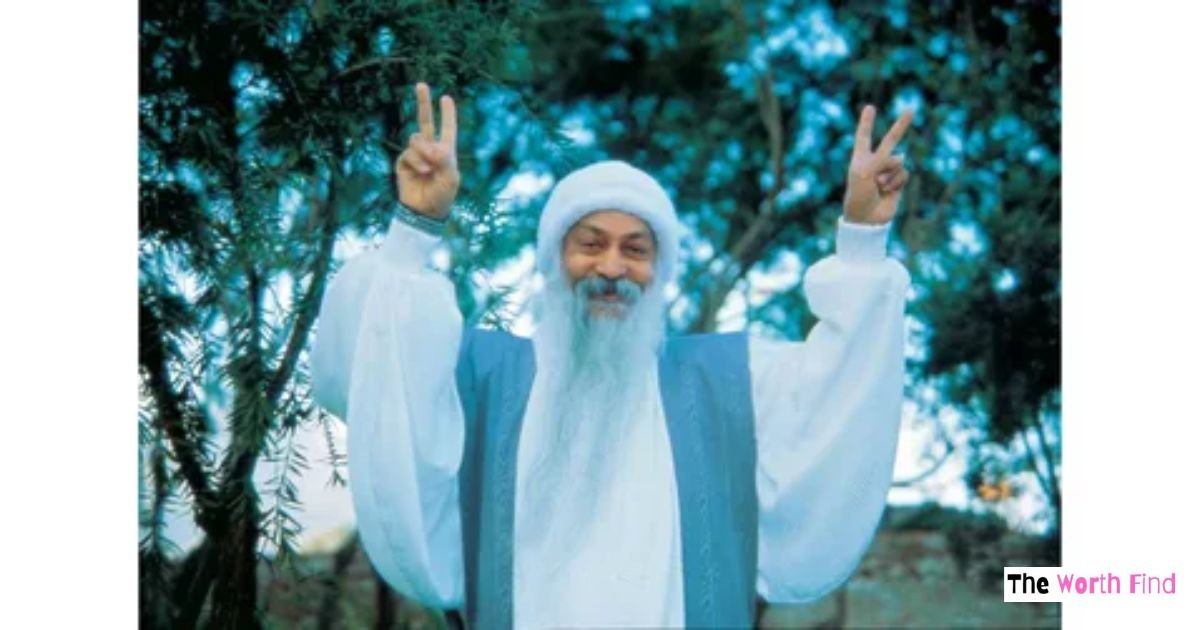
Osho’s Estimated Net Worth
Osho net worth is commonly estimated at around $100 million, particularly in discussions of his wealth at the time of his death in 1990. However, this figure is an estimate, not a verified personal net-worth figure. Some reporting has placed his wealth at more than $100 million, linking the valuation to intellectual property, real estate, brand licensing, and the wider spiritual enterprise.
The main challenge is the lack of a comprehensive public balance sheet detailing Osho’s cash, investments, property, liabilities, and other personal assets. Therefore, the frequently cited $100 million Osho net worth should not be presented as an audited financial figure.
Why Osho’s Exact Net Worth Is Difficult to Verify

Osho’s wealth developed over several decades alongside a large international movement that included ashrams, communes, publishing activities, donations, property, and other organizations. This makes it difficult to determine which assets belonged to Osho personally and which were held by organizations associated with his movement.
Rajneeshpuram illustrates this distinction. The Oregon community was developed on a reported 64,000-acre ranch, but the size or value of organizational property does not automatically establish that it belonged to Osho personally.
Intellectual property adds another layer of complexity. Osho International Foundation states that it owns copyrights covering Osho’s published and unpublished works, including books, audio, video, electronic works, and other material, and that it continues to publish and license those works.
The most accurate conclusion, therefore, is that Osho was associated with substantial wealth, with $100 million being a commonly reported estimate, but his exact personal net worth has not been independently established through a comprehensive public financial record.
Who Was Osho?
Osho’s Real Name and Early Life
Osho was born Chandra Mohan Jain on December 11, 1931, in India, and died on January 19, 1990, in Pune, Maharashtra. During his lifetime, he was known by several names, including Acharya Rajneesh, Bhagwan Shree Rajneesh, and eventually Osho.
From an early age, he developed a strong interest in philosophy, spirituality, meditation, and questions about human consciousness. These interests eventually shaped his public career and his approach to spiritual inquiry.
How Osho Became a Spiritual Teacher
Osho gained recognition through public talks and lectures in India, where he challenged conventional ideas about religion, meditation, relationships, and personal freedom. His unconventional approach attracted a growing following and eventually developed into an international movement.
His teachings were shared through spoken discourses, books, recordings, meditation programs, and centers established in different countries. As his audience expanded, so did the publishing and organizational infrastructure associated with his work.
How Did Osho Make His Money?
Books and Published Discourses
Osho produced an extensive body of spoken teachings that were later published in books and distributed through recordings and other media. His work covered subjects ranging from meditation and philosophy to relationships, spirituality, psychology, and personal development.
The value of these works extended beyond individual book sales. His recorded discourses and written material created a substantial body of intellectual property that could be translated, published, reproduced, and licensed internationally.
Osho International Foundation states that it owns copyrights to Osho’s published and unpublished works across written, audio, video, electronic, and multimedia formats and continues to publish and license them.
Donations and Followers
Financial contributions from followers formed part of the wider Rajneesh movement’s resources. However, it would be inaccurate to treat every donation made to an ashram, commune, or related organization as Osho’s personal income.
This distinction is important because organizational revenue and personal income are not the same thing. Without detailed financial records showing how specific funds were owned or transferred, donations cannot simply be added to Osho’s personal net worth.
Ashrams and Meditation Centers
Osho’s movement established meditation centers and ashrams, most notably in Pune and later in other parts of the world. These centers supported meditation programs, accommodation, publishing, events, and other activities connected with the movement.
Such operations could generate revenue, but their existence does not prove that the resulting funds were personally owned by Osho. A reliable calculation of his wealth would need to establish legal ownership and account for the relevant organizational structures.
Property and Other Assets
Property and other physical assets also played a role in the movement’s financial history. These included land, buildings, vehicles, and other resources connected with its communes and centers.
However, property associated with the Osho movement should not automatically be counted as part of Osho’s personal fortune. Establishing ownership is essential when calculating an individual’s net worth.
Osho and Rajneeshpuram

What Was Rajneeshpuram?
Rajneeshpuram was a large commune established by Osho’s followers in Oregon during the 1980s. The community was developed on a ranch reported by Vanity Fair as covering about 64,000 acres and became a major center of the Rajneesh movement.
Its size and infrastructure reflected the considerable resources available to the movement. The commune included housing, agricultural operations, roads, businesses, and other facilities.
Property and Organizational Wealth
Rajneeshpuram is particularly relevant to discussions of Osho’s wealth because it shows why movement wealth and personal wealth must be considered separately.
Land and other property connected with the commune represented organizational assets. Business activity and contributions from followers also supported the wider operation. These resources help illustrate the financial scale of the Rajneesh movement, but they do not establish Osho’s personal ownership of every asset.
For that reason, asking whether Osho “owned” Rajneeshpuram requires more precision than simply considering the property’s size or value.
- Read More: Queen Shalini Age
Osho’s Famous Rolls-Royce Collection
Why Did Osho Have So Many Rolls-Royces?
Osho became widely known for his extravagant lifestyle, particularly during his time in Oregon. His collection of Rolls-Royce automobiles became one of the most recognizable symbols of his wealth and public image.
The collection also generated controversy because of the contrast between his spiritual teachings and his visible display of luxury. As a result, the cars are frequently mentioned in discussions of Osho’s wealth and assets.
Did Osho Personally Own All the Cars?
The commonly repeated figure is 93 Rolls-Royces, but that number should not be used on its own to calculate Osho’s personal net worth. The vehicles were associated with the Rajneesh community and Osho’s public life, while their precise legal ownership requires specific historical evidence.
This distinction matters because assets associated with a spiritual movement are not automatically equivalent to the personal fortune of its leader.
Osho’s Books and Intellectual Property
Who Owns Osho’s Copyrights?
According to Osho International Foundation, the Foundation is the registered owner of copyrights covering Osho’s published and unpublished words and works. These include written material, audio, video, electronic works, photographs, and other related intellectual property. The Foundation also states that it actively publishes and licenses these works worldwide.
This provides a documented example of the continuing commercial value of Osho’s intellectual property. It also shows why current licensing activity should not be described as money personally earned by Osho after his death.
Osho Trademark and Licensing
The OSHO name also has formal trademark protection. Osho International Foundation states that OSHO is a registered trademark in many countries and across multiple classes of goods and services.
The trademark and licensing of Osho-related works contribute to the continuing commercial presence of the Osho brand. However, ownership and revenue should be attributed to the relevant legal entities rather than automatically treated as Osho’s personal income.
- Read More: RJ Sayema Husband
What Happened to Osho’s Wealth After His Death?
Osho’s Estate
Osho died in January 1990. By that time, his financial affairs were connected with a complex network of organizations, properties, intellectual property, and movement-related assets.
Because a comprehensive public accounting of his personal estate is not readily available, it is difficult to establish exactly which assets formed part of his personal inheritance or how every asset was ultimately distributed.
Osho’s Posthumous Financial Legacy
Osho’s works have continued to circulate after his death through books, recordings, videos, meditation centers, and licensing. Osho International Foundation states that it continues to publish and license his works, demonstrating that his intellectual property retains commercial value decades after his death.
That does not mean Osho personally continues to earn money. Rather, organizations that control or license rights associated with his works continue commercial activities involving his intellectual property.
Osho Net Worth vs. Rajneesh Movement Wealth
One of the biggest sources of confusion surrounding Osho net worth is the failure to distinguish between Osho’s personal assets and the wealth of the broader Rajneesh movement.
| Category | What it represents | Can it be counted as Osho’s personal net worth? |
|---|---|---|
| Personal property | Assets personally owned | Potentially |
| Commune property | Assets held by organizations | Not automatically |
| Donations | Money contributed to movement organizations | Not automatically |
| Copyrights | Intellectual property rights | Depends on legal ownership |
| Trademarks | Brand and intellectual-property rights | Depends on legal ownership |
| Vehicles | Physical assets associated with Osho or his movement | Depends on ownership |
This distinction helps explain why different estimates can produce very different figures. A valuation that combines organizational property, intellectual property, donations, and personal assets can be much broader than a conventional calculation of an individual’s net worth.
So, was all Rajneesh movement wealth personally Osho’s? No, not necessarily. The available evidence does not justify treating every movement asset as part of his personal fortune.
What Can Actually Be Verified About Osho’s Wealth?

The available evidence supports some claims more strongly than others:
| Financial claim | Evidence status |
|---|---|
| $100 million net-worth estimate | Reported estimate |
| Exact personal net worth | Not independently established |
| Rajneeshpuram property | Historically documented |
| Osho books and discourses | Documented |
| Copyright ownership | Documented by Osho International Foundation |
| OSHO trademark | Documented by Osho International Foundation |
| Posthumous licensing | Documented |
| Exact personal cash holdings | Not publicly established |
The $100 million figure is therefore best presented as a reported estimate rather than a verified balance-sheet figure. Independent reporting has also described Osho’s wealth at death as believed to have exceeded $100 million, associating that valuation with intellectual property, real estate, brand licensing, and the broader spiritual enterprise.
The key point is that Osho was associated with substantial wealth and valuable assets, but the precise size of his personal fortune cannot be established with the same certainty as a publicly reported corporate balance sheet.
Osho’s Financial and Cultural Legacy
Osho’s financial legacy continues through the global distribution of his books, recordings, meditation programs, centers, and intellectual property. His teachings remain internationally recognized, while organizations associated with his work continue to manage and license material connected with his name.
His legacy, therefore, extends beyond a single net-worth figure. Publishing, property, organizational activity, intellectual property, and a global following all contributed to a financial and cultural legacy that continued after his lifetime.
Frequently Asked Questions About Osho Net Worth
What was Osho’s net worth when he died?
Osho’s wealth at death has commonly been estimated at around or above $100 million, but the exact figure has not been independently verified.
Was Osho really worth $100 million?
The $100 million figure is widely reported, but it should be treated as an estimate rather than an audited personal net-worth figure.
How did Osho become wealthy?
The financial resources associated with his movement included books, recorded teachings, donations, meditation centers, property, and other organizational activities.
Did Osho personally own Rajneeshpuram?
Rajneeshpuram was a large community established by his followers. Its property and organizational assets should not automatically be treated as Osho’s personal property.
How many Rolls-Royces did Osho have?
The commonly cited figure is 93 Rolls-Royces, although the precise ownership structure of the vehicles should be distinguished from Osho’s personal net worth.
Who owns Osho’s copyrights?
Osho International Foundation states that it is the registered owner of copyrights covering Osho’s published and unpublished works and related media.
Does Osho still make money after his death?
Osho himself cannot receive income after his death. However, his works continue to be published and licensed by organizations managing the associated intellectual property.
What happened to Osho’s wealth after he died?
His financial legacy became connected with estates, organizations, property, intellectual property, and continuing publishing and licensing activities. The exact distribution of his personal assets is not comprehensively documented publicly.
Why are Osho’s net-worth estimates different?
Estimates vary because personal assets, organizational property, donations, intellectual property, and movement resources are sometimes combined, even though they are not necessarily the same thing.
Was all of the Rajneesh movement’s wealth Osho’s personal wealth?
No. Organizational assets and donations cannot automatically be counted as an individual’s personal net worth without evidence of personal ownership.
